For Counselors

Using DSA as supplementary academic evidence

Help students choose the right subject, understand the score report, and present DSA appropriately in university applications.

How to Advise a Student

1. Start with the Major

Use the student's intended field as the anchor. A Core Subject should be recognizable to admissions readers as a major-level academic area.

2. Add Depth Selectively

An Adjacent Subject is optional. Recommend one only when it strengthens the same academic story rather than creating a scattered profile.

3. Time the Window

DSA is organized by quarterly windows. Counsel students to leave enough time for preparation, results, and application deadlines.

How to Present DSA

DSA should be presented as a supplementary academic credential. It does not replace SAT, ACT, AP, IB, A-Level, TOEFL, IELTS, or school transcripts.

Suggested wording: The student completed the Deep Scholastic Assessment in a major-level academic field. The score report provides subject-specific evidence of preparation, live knowledge acquisition, academic thinking, and interest in the intended area of study.
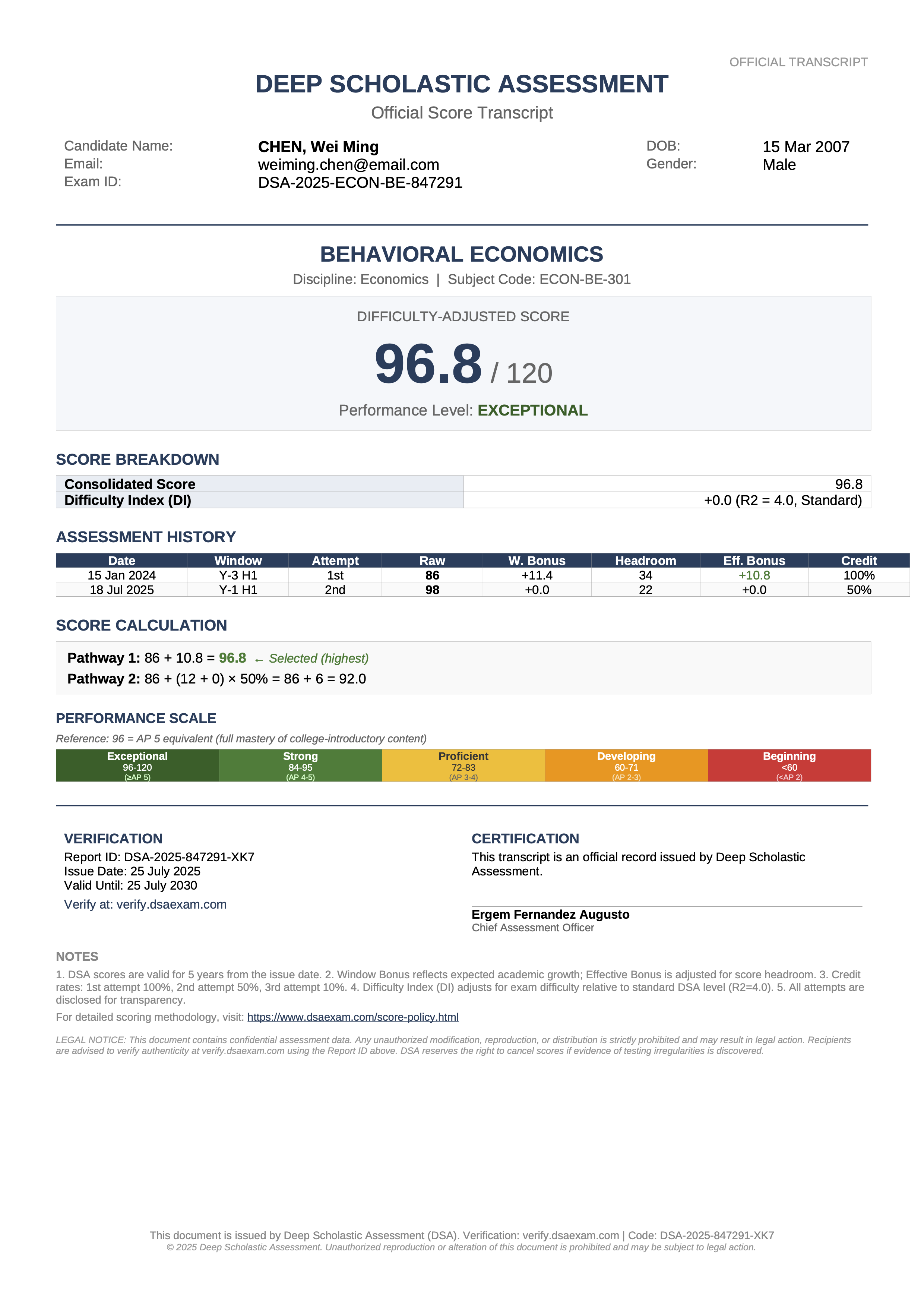
View Sample Score Report
Sample DSA score report

Reading the Score Report

Core Subject

  • 180-minute assessment
  • Prepared papers and live papers reported separately
  • Knowledge acquisition and academic thinking reported separately
  • 0-120 Raw Score and Consolidated Score when attempts apply

Adjacent Subject

  • 90-minute assessment
  • Optional, specialized concentration evidence
  • Separate 0-120 subject score
  • Not selected is not treated as a zero or missing result

Need Help Advising a Student?

Contact DSA for subject-selection questions, score-report interpretation, or school advising support.

Contact DSA